Best Website Builder for 500 Product Stores: 2026 Guide
Editorial Team··10 min read

Table of Contents
- Quick Comparison: Best Website Builders for 500 Product Stores
- How We Evaluated These Platforms
- 1. Aleyo: AI-Powered Automation for Large Catalogues
- 2. Shopify: Dedicated E-Commerce Infrastructure
- 3. Wix Studio: Design Flexibility for Product Catalogues
- 4. Squarespace: Design-First Presentation for Product Ranges
- 5. Webflow: Bespoke E-Commerce Experiences
- 6. Hostinger Website Builder: Budget-Friendly Rapid Setup
- Frequently Asked Questions
Last Updated: 11 September 2026
Quick Comparison: Best Website Builders for 500 Product Stores
Choosing the best website builder for 500 product stores comes down to one question: can the platform manage a catalogue that size without collapsing under its own weight?
The short answer: Aleyo automates planning, design and product management in a live workspace, while Shopify remains the default for pure retail infrastructure. Wix Studio, Squarespace, Webflow and Hostinger each solve narrower problems well.
| Platform | Starting Price | Best For | Standout Feature |
|---|---|---|---|
| Aleyo | Free credits on sign-up | Automated catalogue builds | Four specialist AI agents |
| Shopify | £25/month | Dedicated retail operations | Advanced inventory tracking |
| Wix Studio | £18/month | Agency design workflows | Custom CSS and code injection |
| Squarespace | £14/month | Design-led product presentation | Premium responsive templates |
| Webflow | £11/month | Bespoke storefronts | Visual canvas, clean code |
| Hostinger | £2.59/month | Budget rapid setup | AI site generation |
How We Evaluated These Platforms
We scored each platform against six criteria that matter once a catalogue passes roughly 500 products: bulk product upload capability, inventory management depth, scalability under load, design flexibility, total monthly cost, and how much technical knowledge the setup demands. A platform that excels at ten products but buckles at five hundred did not make this list.
1. Aleyo: AI-Powered Automation for Large Catalogues
Aleyo is a website development platform that automates the planning, design and engineering of an online store through four specialist AI agents working in sequence. For a 500-product catalogue, that means the structural work, category architecture, product templates, collection pages, is generated rather than hand-built, and every change happens in a live workspace where you edit word by word directly on the canvas.
Key Features for 500+ Product Stores
- Integrated AI modules for e-commerce, blogging and branding, so catalogue pages and supporting content share one system
- Real-time traffic, conversion and SEO health monitoring, which matters when hundreds of product pages need consistent optimisation
- Instant generation of brand assets and marketing content for launch campaigns
- Simplified lead capture and management for stores that sell wholesale alongside retail
- 60 free credits on sign-up, enough to test the workflow before committing
Pricing and Pros/Cons
Pricing depends on usage and catalogue size, so check Aleyo's website for current figures and a quote.
Pros: The automation genuinely removes the build phase that stalls most catalogue projects. The live workspace offers a direct editing model, without preview-refresh loops.
Cons: It is a newer platform than the established names here, so the third-party app ecosystem is smaller.

2. Shopify: Dedicated E-Commerce Infrastructure
Shopify is the benchmark for dedicated retail infrastructure, and its inventory tools are built for exactly this catalogue size. Advanced inventory tracking, automated tax and shipping calculations, and an extensive app marketplace mean you can scale functionality without rebuilding. The catch is cost creep: transaction fees apply unless you use Shopify Payments, and the apps that make large catalogues manageable are mostly paid add-ons.

Key Features for 500+ Product Stores
- Inventory tracking designed for 500+ products with location-level stock control
- Integrated payment gateway support and automated tax calculations
- App marketplace covering bulk editing, feeds and multi-channel sync
- Reliable uptime and security infrastructure
Pricing and Pros/Cons
Pros: Industry-leading e-commerce depth and dependable hosting. Cons: Transaction fees outside Shopify Payments, and the real monthly cost lands well above the sticker price once essential apps are added.
3. Wix Studio: Design Flexibility for Product Catalogues
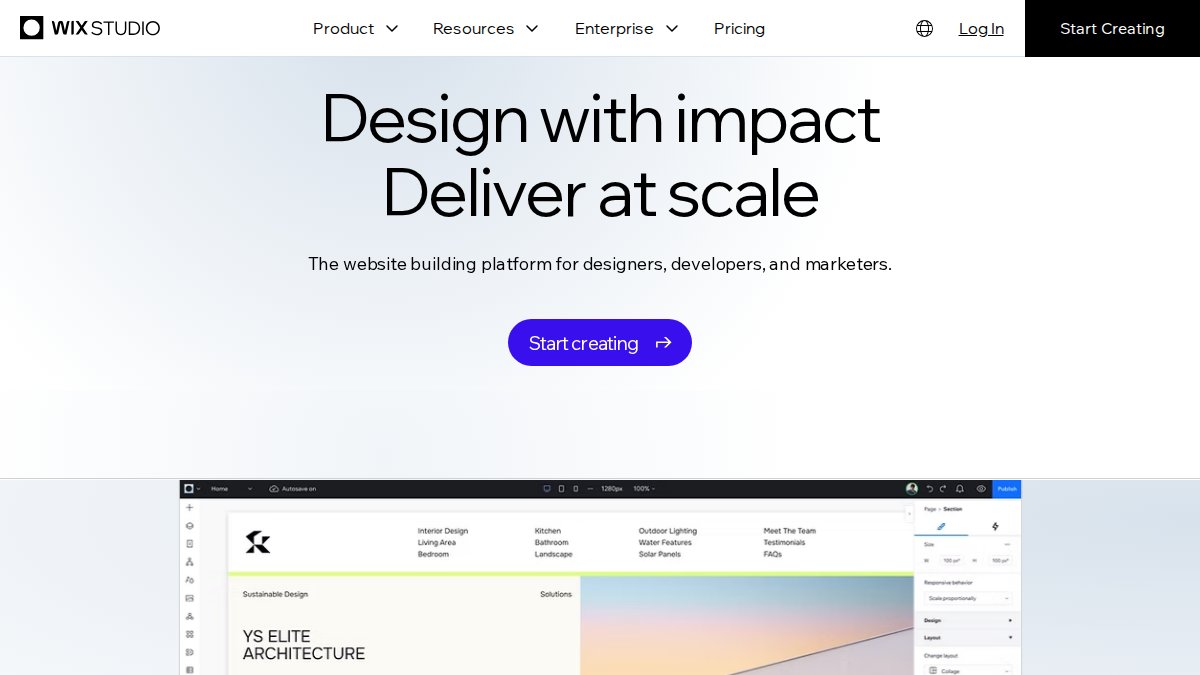
Wix Studio targets agencies and businesses managing complex site structures, and its multi-site management makes it a sensible fit if you run several storefronts. Responsive AI-driven design tools and custom CSS give you control that standard Wix does not, though the learning curve is steeper than its consumer sibling. For a 500-product catalogue, the e-commerce dashboard handles the basics competently; heavy automation is where it thins out.
Key Features for 500+ Product Stores
- Responsive AI-driven design tools with custom CSS and code injection
- Integrated e-commerce management dashboard
- Multi-site management for agencies scaling client work
Pricing and Pros/Cons
Pros: Highly customisable editor and strong agency workflow tools. Cons: Steeper learning curve, and large-catalogue automation requires more manual setup than dedicated platforms.
4. Squarespace: Design-First Presentation for Product Ranges
Squarespace earns its place on presentation. Its templates showcase product imagery better than almost anything at this price, and built-in inventory and order management covers straightforward retail. Where it falls short is extensibility: the third-party integration library is noticeably thinner than Shopify's, which bites when you need bulk feed management or multi-channel inventory sync across hundreds of SKUs.

Key Features for 500+ Product Stores
- Professional mobile-responsive templates built for product photography
- Built-in inventory and order management
- Integrated email marketing and SEO tools
- Support for both physical and digital product sales
Pricing and Pros/Cons
Pros: Superior template design and genuine all-in-one simplicity. Cons: Limited app integrations for complex catalogue operations.
5. Webflow: Bespoke E-Commerce Experiences
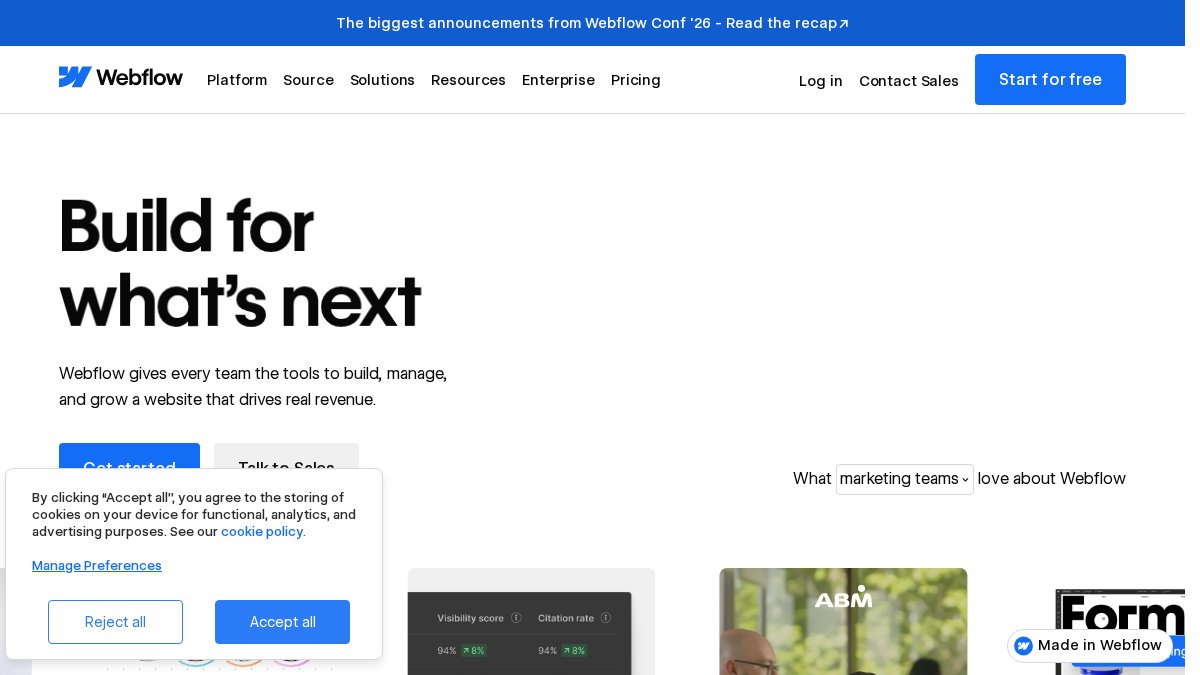
Webflow gives designers complete control over HTML, CSS and JavaScript without manual coding, and its CMS handles large product databases cleanly. Customisable checkout and cart experiences make it the pick for stores where the buying experience itself is the differentiator. It is not a shortcut, though. The interface assumes real technical fluency, and for a 500-product store that means either hiring that skill or budgeting serious setup time.
Key Features for 500+ Product Stores
- Visual canvas for fully custom e-commerce layouts
- CMS for managing large product databases
- Customisable checkout and cart experiences
- High-performance hosting infrastructure
Pricing and Pros/Cons
Pros: Unmatched design freedom and clean, production-ready code. Cons: The complexity is real, this is not a platform for a non-technical owner managing 500 SKUs alone.
6. Hostinger Website Builder: Budget-Friendly Rapid Setup
Hostinger competes on price and speed. AI-driven site generation and a drag-and-drop editor get a small store live quickly, and a free domain and email are bundled in. The honest limitation: advanced e-commerce features thin out fast at scale, so a 500-product catalogue will likely outgrow it. Treat it as a starting point for a smaller range, not the destination for a mid-sized inventory.

Key Features for 500+ Product Stores
- AI-driven site generation and content writing
- Drag-and-drop editor for straightforward store management
- Integrated marketing and SEO tools
- Free domain and email included
Pricing and Pros/Cons
Pros: Extremely competitive pricing and a genuinely user-friendly interface. Cons: Limited advanced e-commerce capability for large-scale operations.
| Platform | Bulk Upload | Inventory Sync | Technical Skill Needed | Scales Past 500 SKUs |
|---|---|---|---|---|
| Aleyo | Automated | Integrated | Low | Yes |
| Shopify | Via apps | Advanced | Low to medium | Yes |
| Wix Studio | Manual setup | Dashboard-level | Medium | Partial |
| Squarespace | Manual | Basic | Low | Partial |
| Webflow | Via CMS | Custom build | High | Yes |
| Hostinger | Manual | Basic | Low | No |
Frequently Asked Questions
Is 500 products considered a large inventory for an online store?
500 products sits in the mid-sized range for online retail. It's large enough that manual stock tracking becomes impractical, but not so large that you need enterprise-level systems. Most website builders with dedicated e-commerce features handle this volume comfortably. The key is choosing a platform with automated inventory management, bulk upload tools, and the ability to scale further without a full migration.
Which e-commerce platforms handle bulk product uploads best?
Platforms with native CSV import tools and app marketplaces tend to handle bulk uploads most smoothly. Shopify and WordPress.com with WooCommerce both offer reliable CSV importers that can process hundreds of SKUs at once. For stores planning regular catalogue updates, look for a bulk product upload website builder that supports scheduled imports and automatic field mapping to reduce manual data entry.
Do I need a dedicated e-commerce platform for 500 products, or can I use a standard website builder?
It depends on your growth plans. A standard website builder can display 500 products, but dedicated e-commerce platforms offer better inventory syncing, order management, and scalability. If you sell across multiple channels or plan to grow beyond 500 SKUs, a platform built for e-commerce will save time and reduce errors. If your catalogue is stable and sales are straightforward, a standard builder with e-commerce add-ons may suffice.
How do transaction fees compare across top e-commerce builders?
Transaction fees vary by platform and payment gateway. Some builders charge no additional fees when you use their native payment system, while others apply a percentage per transaction if you use third-party gateways. Shopify, for example, waives extra fees with Shopify Payments. Always check the fee structure alongside the monthly subscription cost, as transaction fees can add up quickly at 500 products.
What features are essential for managing a 500-product catalogue?
Look for automated inventory tracking, bulk CSV import and export, variant management for sizes and colours, and real-time stock syncing across sales channels. SEO tools for product pages, customer review functionality, and abandoned cart recovery also matter. A platform with a built-in CMS for product databases, like Webflow or WordPress.com, gives you more control over how products are displayed and found.
A 500-product catalogue exposes every weakness in a website builder, usually at the worst possible moment. Aleyo was built for exactly this problem: four specialist AI agents handle planning, design and engineering in sequence, a live workspace lets you edit directly on the canvas, and real-time traffic and SEO monitoring keeps hundreds of product pages healthy after launch. Start building with Aleyo and launch a catalogue that scales with you.
FAQs
- 500 products sits in the mid-sized range for online retail. It's large enough that manual stock tracking becomes impractical, but not so large that you need enterprise-level systems. Most website builders with dedicated e-commerce features handle this volume comfortably. The key is choosing a platform with automated inventory management, bulk upload tools, and the ability to scale further without a full migration.
- Platforms with native CSV import tools and app marketplaces tend to handle bulk uploads most smoothly. Shopify and WordPress.com with WooCommerce both offer reliable CSV importers that can process hundreds of SKUs at once. For stores planning regular catalogue updates, look for a bulk product upload website builder that supports scheduled imports and automatic field mapping to reduce manual data entry.
- It depends on your growth plans. A standard website builder can display 500 products, but dedicated e-commerce platforms offer better inventory syncing, order management, and scalability. If you sell across multiple channels or plan to grow beyond 500 SKUs, a platform built for e-commerce will save time and reduce errors. If your catalogue is stable and sales are straightforward, a standard builder with e-commerce add-ons may suffice.
- Transaction fees vary by platform and payment gateway. Some builders charge no additional fees when you use their native payment system, while others apply a percentage per transaction if you use third-party gateways. Shopify, for example, waives extra fees with Shopify Payments. Always check the fee structure alongside the monthly subscription cost, as transaction fees can add up quickly at 500 products.
- Look for automated inventory tracking, bulk CSV import and export, variant management for sizes and colours, and real-time stock syncing across sales channels. SEO tools for product pages, customer review functionality, and abandoned cart recovery also matter. A platform with a built-in CMS for product databases, like Webflow or WordPress.com, gives you more control over how products are displayed and found.